
Revision Resources

Physics and Maths Tutor
This is a great website where you can access: practice questions; past papers; model answers and video solutions. I use this website for GCSE, iGCSE and A level students, it covers all UK exam boards.
These resources are available at: https://www.physicsandmathstutor.com
Corbett Maths
This website allows you to access excellent instructional videos, practice questions and worked solutions. This is primarily a resource for GCSE and iGCSE level topics, it is suitable for all uk exam boards.
These resources are available at: https://corbettmaths.com
BBC Bitesize
This site covers all GCSE maths topics and it has the advantage of differentiating content across the different GCSE exam boards.
You will find GCSE resources available at: https://www.bbc.co.uk/bitesize/subjects/z38pycw
Desmos
This site allows you to explore the graphing of mathematical functions, it is mainly useful for GCSE Higher and ‘A’ level students.
These resources are available at: https://www.desmos.com/calculator
Calculator Skills
Many students use their mobile phone to do their maths homework, they do not routinely use calculators. Mobile phones cannot be used in GCSE, iGCSE and A level examinations, only permitted calculators can be used. Consequently owning the right calculator and understanding how to use its functions are key to optimising a student’s exam performance.
Calculators are permitted in two of the three GCSE maths examinations, in both iGCSE and all ‘A’ level papers. Students should consider replacing batteries prior to the exam, using a solar powered calculator, or having a spare set of batteries with them when going into the exam.
In my experience a graphical calculator is absolutely essential for ‘A’ level examinations, despite their relatively high cost they retain their value well for potential sale after the examinations.
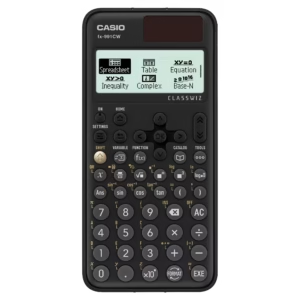
I would recommend the Casio FX-991CW for GCSE and iGCSE Mathematics and Science exams.
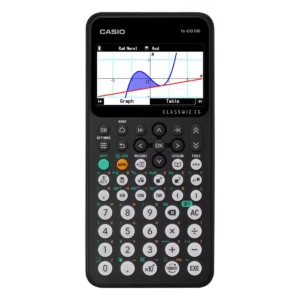
I would recommend the Casio FX-CG50, or the FX-CG100, for A level Maths, Further Maths and Science exams. Both of these are graphical calculators, which allow users to create on screen graphs. Visually representing a mathematical problem can greatly assist in solving it. Both of these calculators also have excellent statistics functionality too. The CG100 is a newer model and is a little more straightforward to use than the CG50.
Casio provide some excellent calculator training resources, they are available free at: https://education.casio.co.uk/all-resources/
Maths Formulae Sheets
Students studying GCSE (Foundation and Higher), iGCE and A level maths are provided with maths formulae sheets, it is useful for candidates to familiarise themselves with these formulae prior to the exam. During ‘A’ level examinations they can provide a ‘lifeline’ if students are unsure of how to answer a question. For iGCSE students the formulae are printed in the actual exam paper, for the other exams they are printed in separate sheets or booklets. The content of the formulae sheets is the same across all exam boards, it is just the format and layout which may differ. I have provided links to the AQA formulae sheets by way of examples.
GCSE Foundation Maths Formulae Sheet: https://cdn.sanity.io/files/p28bar15/green/01e9550311938f234bf30d6f5b17a3de5fcf2a37.pdf
GCSE Higher Maths Formulae Sheet: https://cdn.sanity.io/files/p28bar15/green/a79c9e8a3e53e261503e3de0214b0a777cfdf90f.pdf
GCSE Further Maths Formulae Sheet: https://cdn.sanity.io/files/p28bar15/green/dbfae7eeab8a2339190e93b8664358b9aaf13c2f.pdf?_gl=11igg268_gcl_au*OTE5MjkyNTI0LjE3NTU5NTUxNzA.
GCE ‘A’ level Formulae Sheet: https://cdn.sanity.io/files/p28bar15/green/95bd0473d984108d43ac7434bc3386557d8f7db8.pdf?_gl=11sfo8ic_gcl_au*OTE5MjkyNTI0LjE3NTU5NTUxNzA.
Top 10 Tips
1. Practice previous exam papers, you don’t need to just focus on your own exam board as the syllabus is the same across all of the exam boards. In fact this is a good thing to do, in order that you get used to exam questions being written in slightly different ways.
2. Identify areas that you need to work on, use the resources that I have highlighted to access explanatory videos, or video solutions to the papers that you’ve been working on.
3. When doing revision questions have a copy of your formulae sheet handy so that you become familiar with when you might need to use it.
4. Ensure to use your calculator NOT your mobile phone when working through homework or past papers. This will get you familiar with your calculator and its functionality.
5. Make sure that you know how to access the different functions on your calculator, e.g. trigonometric functions, power and root functions, simultaneous equations and the polynomial solver.
6. Make sure you always write down your working out, this maximises your chances of point scoring during the exam. If you enter something into your calculator make sure that this is written down on your answer paper. You may get method marks, even if your final answer is incorrect.
7. Don’t be scared to write something in words, in order to explain your working out, as this will help the marker.
8. Space out your working, if you make a mistake and cross things out then use the additional sheets in the answer booklet, or ask for more paper. Remember, the easier it is to read, the easier it is to mark.
9. When doing mocks or the actual exam go through the paper and tackle the questions that you are able to start and progress through. If you are unsure of a question, or how to start it, move on and come back to it, you should have plenty of time.
10. Try and score the maximum number of marks, but be conscious of the grade boundaries and what you are trying to achieve. In a Foundation GCSE maths the boundary for a Grade 4 is typically around 60%, a Grade 5 around 75%. For GCSE Higher maths the Grade 4 boundary is around 20%, Grade 6 around 45% and Grade 9 around 85%. For A level typical boundaries are: Grade ‘C’ 43%, Grade ‘A’ around 70%. Do not panic if you can’t do a question!
‘A’ Level Maths ‘Large Data Sets’
The statistics elements of ‘A’ level exams require students to familiarise themselves with, and analyse, specific large sets of data, for the purposes of the exams the data set is known as the Large Data Set (LDS). For example AQA utilise a data set containing information about vehicle registrations, whereas Edexcel’s LDS contains information about weather patterns. Students have frequently told me that this aspect of the syllabus has not been covered in-depth within the classroom environment.
In order to successfully tackle exam questions relating to the LDS, typically one or two per statistics exam, it is essential that students become familiar with the relevant data set. They should download the LDS and conduct some analysis, typically using Microsoft Excel, or another suitable spreadsheet programme, prior to the exam. I have done comprehensive analysis of the data sets used in the AQA and Edexcel exams, as well as the previous exam questions relating to this topic. The following links allow you to directly download the relevant exam board’s large data set in Excel format.
AQA LDS, available for free download on this link: https://filestore.aqa.org.uk/resources/mathematics/AQA-AS-A-MATHS-LDS-2019-2020.XLSX
OCR LDS, please note there are several data sets used for OCR Mathematics A and OCR (MEI) Mathematics B, please ensure that you are aware of which one will be tested in the exam. Data sets are available for free download on this page: https://www.ocr.org.uk/blog/why-three-large-data-sets-for-the-mei-specification/#:~:text=The%20large%20data%20sets%20(LDS,to%20when%20it%20is%20used.&text=So%20if%20you%20teach%20A,are%20available%20on%20Teach%20Cambridge.
Pearson Edexcel LDS, available for free download on this link: https://qualifications.pearson.com/content/dam/pdf/A%20Level/Mathematics/2017/specification-and-sample-assesment/Pearson%20Edexcel%20GCE%20AS%20and%20AL%20Mathematics%20data%20set%20-%20Issue%201%20(1).xls
Revise Smartly
Effective revision makes your exams easier!